

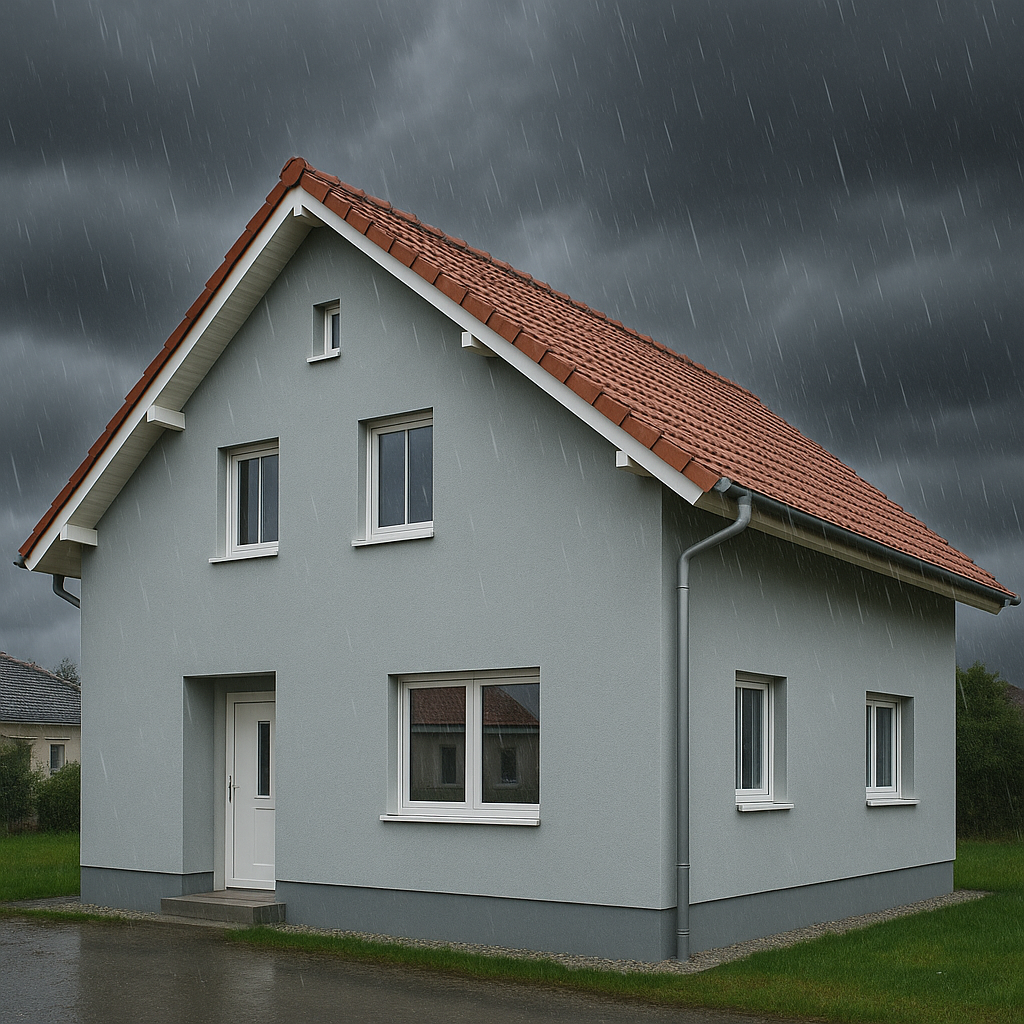
The development of silicone-based coatings has been one of the most decisive steps in the chemistry of architectural paints during the 20th century. From the first silicate materials based on water glass to modern hybrids of silicone resins and acrylic polymers, the evolution of Si–O–Si bonds has provided a solution to a long-standing dilemma: how can a paint be both water-repellent and permeable to water vapour?
Today, silicone paints and renders represent the optimal balance between inorganic and organic systems. They combine the natural appearance and “breathability” of inorganic materials with the durability and elasticity of polymeric coatings. Their technology is based on the ability of silicone resins to form a microporous, hydrophobic yet permeable layer, offering long-term protection against moisture, pollution, and microorganisms.
In Europe, and particularly in regions with strong fluctuations in humidity and temperature such as the Mediterranean, silicone paints are considered a benchmark for the preservation of façades, historic monuments, and modern buildings. Their technology is based on Künzel’s façade protection theory, according to which the ideal coating should absorb minimal water — low w-value — while simultaneously allowing the free diffusion of water vapour — low sd-value.
From Water Glass to Silicone Polymers
The first water-soluble silicate paints were developed as early as the 19th century and were characterised by their inorganic chemistry: Si–O–Si bonds were formed through alkaline sodium silicate — water glass. Their excellent vapour permeability — sd < 0.1 m — was accompanied, however, by high water absorption and low elasticity.
The need to improve adhesion, storage stability, and durability led, during the 1970s, to the development of so-called silicone-modified silicate or silicone–silicate hybrid systems — silicate emulsions. With the addition of polymer emulsions, water glass gained better adhesion and easier application, without losing its characteristic permeability.
Despite these advantages, silicate coatings remained relatively brittle and sensitive to cracking. In addition, their high water absorption made them unsuitable for continuous exposure to rain or coastal environments. The answer came with silicone resins.
Chemistry and Structure of Silicone Resins
Silicone resins are three-dimensionally crosslinked polysiloxanes — R–Si–O–Si–R′ — in which the organic groups, usually methyl or phenyl, regulate elasticity and compatibility with organic components.
The Si–O–Si bridge has a higher bond energy than C–O or C–C bonds, which explains the excellent resistance of silicone resins to heat, ultraviolet radiation, and chemical attack.
Figure 1. Structure of polysiloxanes
In silicone paints for buildings, these resins are mainly used in the form of silicone resin emulsions. During drying, the resin particles are absorbed onto inorganic fillers and pore walls, forming a thin waterproof film.
This film does not seal the pores; it lines them. It therefore allows water vapour diffusion while preventing the penetration of liquid water.
This combination makes silicone coatings a material with hydrophobicity without diffusion blockage, ideal for façade protection.
The Role of w and sd Parameters
The behaviour of coatings is quantitatively defined by two critical parameters, according to EN 1062-1 and Künzel’s theory:
- w24-value: the rate of capillary water absorption, expressed in kg/m²·√h.
- sd-value: the equivalent air layer thickness corresponding to water vapour diffusion resistance, expressed in metres.
For a coating to be considered both breathable and water-repellent, it must combine a low w-value — ≤ 0.1 kg/m²·√h — and a low sd-value — ≤ 0.14 m.
Unlike acrylic systems, silicone systems achieve this balance thanks to their microporous yet hydrophobic structure.
By contrast, acrylic or vinyl paints, especially when formulated below the critical PVC — CPVC — create an almost continuous film with very high diffusion resistance, often sd > 2 m. They protect against rain, but they trap moisture inside the walls, eventually leading to peeling or blistering of the film and subsequent damage to the substrate.
Table 1. Diffusion and Water Absorption Parameters According to EN 1062-1 and EN ISO 7783
| Parameter | Description / Interpretation | Unit | Reference Standard | Category | Classification Limits | Interpretation |
|---|---|---|---|---|---|---|
| w-value | Rate of capillary water absorption. It expresses the ability of the paint to absorb liquid water during exposure to rain. | kg/m²·√h | EN 1062-3 | W1 — Low / W2 — Medium / W3 — High | W1: w ≤ 0.1 / W2: 0.1 < w ≤ 0.5 / W3: w > 0.5 | The lower the w-value, the higher the resistance to moisture. Silicone paints are usually classified as W1. |
| sd-value | Equivalent air layer thickness corresponding to water vapour diffusion resistance. It describes the breathability of the film. | m | EN ISO 7783 | V1 — High permeability / V2 — Medium / V3 — Low | V1: sd < 0.14 / V2: 0.14 ≤ sd ≤ 1.4 / V3: sd > 1.4 | The lower the sd-value, the higher the breathability. Silicone paints are usually classified as V1. |
| sd × w | Balance index between water tightness and breathability, according to Künzel’s theory. | kg/m²·h½·m | EN 1062-1 | — | Recommended limit: sd × w ≤ 0.1 | Ensures that the coating releases more moisture than it absorbs. This is the ideal condition for silicone paints. |
PVC and the Porous Structure of the Film
The microstructure of silicone paints is strongly determined by the filler-to-resin ratio. PVC — Pigment Volume Concentration — expresses the percentage of the total volume occupied by pigments and fillers.
Equation 1. PVC calculation formula
When PVC exceeds CPVC — Critical Pigment Volume Concentration — the film ceases to be continuous and develops open pores. These pores allow water vapour diffusion, but also the entry of water.
This is where silicone resin intervenes: it lines the pore walls with a thin hydrophobic layer, creating a water-repellent porous structure.
Thus, silicone coatings are positioned “above CPVC”, but with porosity fully lined by a silicone film. By contrast, acrylic coatings below CPVC are closed and show low breathability, while silicate coatings above CPVC are excessively open and absorbent.
The optimum value for silicone paints is typically around PVC 60–65%, where low w and low sd are combined.
Hydrophobicity and the Physical Behaviour of the Surface
The characteristic beading effect — the ability of water to form spherical droplets on the surface — is due to the orientation of methyl groups, –CH₃, in silicone resins towards the outer surface of the film.
The result is high contact angles, usually 120°–130°, compared with approximately 80° for common acrylics.
Figure 2. Beading effect
Figure 3. Contact angle
This property is not merely aesthetic. Rain droplets remove dust and organic pollutants, keeping the façade clean for years. In addition, the porous substrate remains dry and thermally stable, limiting the formation of salts and microorganisms.
Comparative Analysis of the Main Technologies
Table 2. Comparative Table of Commercially Available Technologies
| Category | Structure / Resin | Water Absorption — w | Diffusion — sd | Advantages | Disadvantages |
|---|---|---|---|---|---|
| Acrylic / Styrene-acrylic | Organic polymers below CPVC | Very low | Very high | Good adhesion, economical | Trap moisture |
| Silicate coatings | Water glass — Na/K silicate | Very high | Very low | Absolute breathability, chemical bond with cementitious substrates | Brittleness, water absorption |
| SIL coatings — with silicate fillers | Acrylic + silica fillers | Medium | Low | Good breathability | Increased absorption, limited durability |
| Silicone coatings | Silicone resin emulsion + acrylic | Very low | Low | Hydrophobicity, breathability, cleanliness, durability | Higher cost, requires very good formulation |
The comparison above explains why silicone paints are considered the “gold standard” for exterior façades. They are the only materials that achieve an inverse relationship between w and sd, meaning high water vapour permeability combined with minimal liquid water absorption.
Künzel’s Façade Protection Theory
The fundamental principle of Künzel’s theory is based on the observation that successful wall protection does not depend only on waterproofing, but on the ability of masonry to balance water absorption and water release.
A paint must limit capillary absorption without preventing water vapour diffusion.
Künzel expressed this relationship through two physical parameters:
the sd-value, which expresses the film’s resistance to water vapour diffusion;
and the w24-value, which describes the rate of liquid water absorption through the pores.
The product of these two values, sd × w24, is an index of balance between water tightness and breathability.
A material is considered “balanced” when this product remains below 0.1 kg/m²·h½·m, meaning that the coating allows the wall to release more water than it absorbs during rainfall.
Silicone resins achieve this balance in a unique way. Their hydrophobic matrix reduces w24 to levels comparable with acrylics, while their open microporous structure keeps sd low, allowing continuous water vapour diffusion.
The result is a façade that dries faster after rain, reducing the residence time of moisture in masonry and preventing the development of fungi, salts, and delamination.
This theory formed the basis for European standardisation — EN 1062-1 — which classifies coatings into three water vapour permeability classes, V1–V3, and three water absorption classes, W1–W3.
Silicone coatings typically achieve V1 / W3, meaning high breathability and low water absorption — the ideal condition for the natural balance of the building envelope.
Microporous Films and Diffusion Mechanisms
The performance of silicone paints depends not only on the chemistry of the resin, but also on the morphology of the film formed after water evaporation.
During drying, the silicone resin emulsion and the acrylic phase partially coalesce, forming a pore network with an average diameter below one micrometre.
These pores allow the transport of water vapour through molecular diffusion, but they are too small to allow liquid water flow through capillaries.
This balance is due to the different nature of the forces acting in each case:
- Water vapour moves due to a difference in partial pressure and passes through the micropores without obstruction.
- Liquid water requires continuous capillary networks, which do not exist in silicone paints because the pore surfaces are lined with low-surface-energy methylsiloxanes.
Thus, the film is permeable to gases but not to liquids. This selective permeability explains why a silicone coating can have an sd coefficient as low as 0.1 m and, at the same time, a w-value lower than 0.05 kg/m²·√h.
The microstructure of the pores is significantly influenced by the filler content and particle size. Fine silicate powders — silica, talc — contribute to the formation of a microporous network and increase surface stability.
If PVC exceeds CPVC excessively, the pores interconnect and absorption increases. Conversely, an excessive amount of resin closes the pores and reduces breathability.
The objective is a film above CPVC, but with controlled microporosity, so that it remains functional throughout its service life.
From a physical point of view, the effectiveness of these films results from a combination of surface tension, contact angle, and local diffusion phenomena — a mechanism similar to the one that allows the lotus leaf to remain dry.
Over time, the stability of this microporous network is the key to maintaining the function of the paint: repelling water, allowing the substrate to breathe, and keeping the surface clean.
Pollution Mechanisms and Cleanliness Retention
A critical advantage of silicone paints is their reduced tendency to retain dirt.
The combination of low surface energy and rapid water run-off prevents the accumulation of dust and microbiological deposits.
Laboratory and outdoor studies have shown that dirt pick-up tendency correlates more strongly with filler volume — PVC — than with the type of resin.
The higher the PVC, the rougher the surface and the more difficult it becomes for organic pollutants to adhere. Silicone paints, with PVC around 65%, offer the ideal roughness for self-cleaning behaviour without chalking.
In long-term exposure tests, silicone resin surfaces show lower changes in lightness — ΔL — and more stable colour appearance compared with acrylics, especially in humid or urban environments.
New Technologies and Hybrid Systems
In recent years, research has focused on improving the compatibility between the inorganic silicone phase and the organic polymer phase.
So-called nanohybrid resins — silica–latex nanocomposites — combine colloidal SiO₂ with an acrylic copolymer at molecular scale, achieving even lower w-values and higher resistance to dirt pick-up.
In addition, new high-solids methyl silicone resins — 50–60% solids — make it possible to produce paints with lower volatile organic compound content, VOC < 30 g/L, without compromising breathability.
Finally, the incorporation of nano-titanium dioxide — TiO₂ — with photocatalytic properties into silicone or silicate systems creates “active” surfaces capable of breaking down organic pollutants and nitrogen oxides.
Although this technology is still at the optimisation stage, it indicates the future direction of paints with environmental functionality.
Applications and Architectural Significance
Today, silicone paints and renders are used in a wide range of architectural applications:
- protection and aesthetic upgrading of façades in historic and modern buildings;
- external thermal insulation composite systems — ETICS;
- restoration of highly breathable renders;
- painting of cementitious or lime-based mortars;
- high-durability coatings for urban, coastal, or industrial environments.
The ability to achieve matt or satin finishes, combined with colour stability and low chalking, has established silicone resins as the main high-quality choice for exterior building projects.
Epilogue
The technology of silicone paints and renders represents the most mature and scientifically documented approach to façade protection.
It integrates the experience of mineral silicate systems and the adaptability of acrylics, overcoming the limitations of both.
The principle of a hydrophobic porous structure — where water is repelled while water vapour diffuses — remains the cornerstone of their success.
Through precise PVC adjustment and the use of stabilised silicone resin emulsions, these paints offer long-term durability, natural appearance, and outstanding protection against moisture and pollutants.
Within the framework of European standards for energy efficiency and long-term building maintenance, silicone paints and renders are not only an aesthetic choice. They are a tool for protecting the built environment, using a material that combines chemistry with physics, and technology with durability.
Bibliography
Kittel, H. (2003). Paints, Coatings and Solvents — 3rd ed. Wiley-VCH.
Heilen, W., & Herrwerth, S. (2015). Silicone Resins and Their Combinations — 2nd revised ed. Hanover, Germany: Vincentz Network. ISBN 978-3-86630-697-4.
Koleske, J. V. — Ed. (2012). Paint and Coating Testing Manual: 15th Edition of the Gardner-Sward Handbook. ASTM International.
Bieleman, J. — Ed. (2000). Additives for Coatings. Wiley-VCH.
Wacker Chemie AG. (2019). SILRES® SREP – Silicone Resin Emulsion Paints: Technical Brochure. Munich: Wacker Chemie AG.
Wacker Chemie AG. (2021). SILRES® BS – Silicone Resin Technology for Building Protection: Technical Information. Munich: Wacker Chemie AG.
Institute of Coating Technologies. (2023). Paint Technology. Athens: IoCT Publications.