

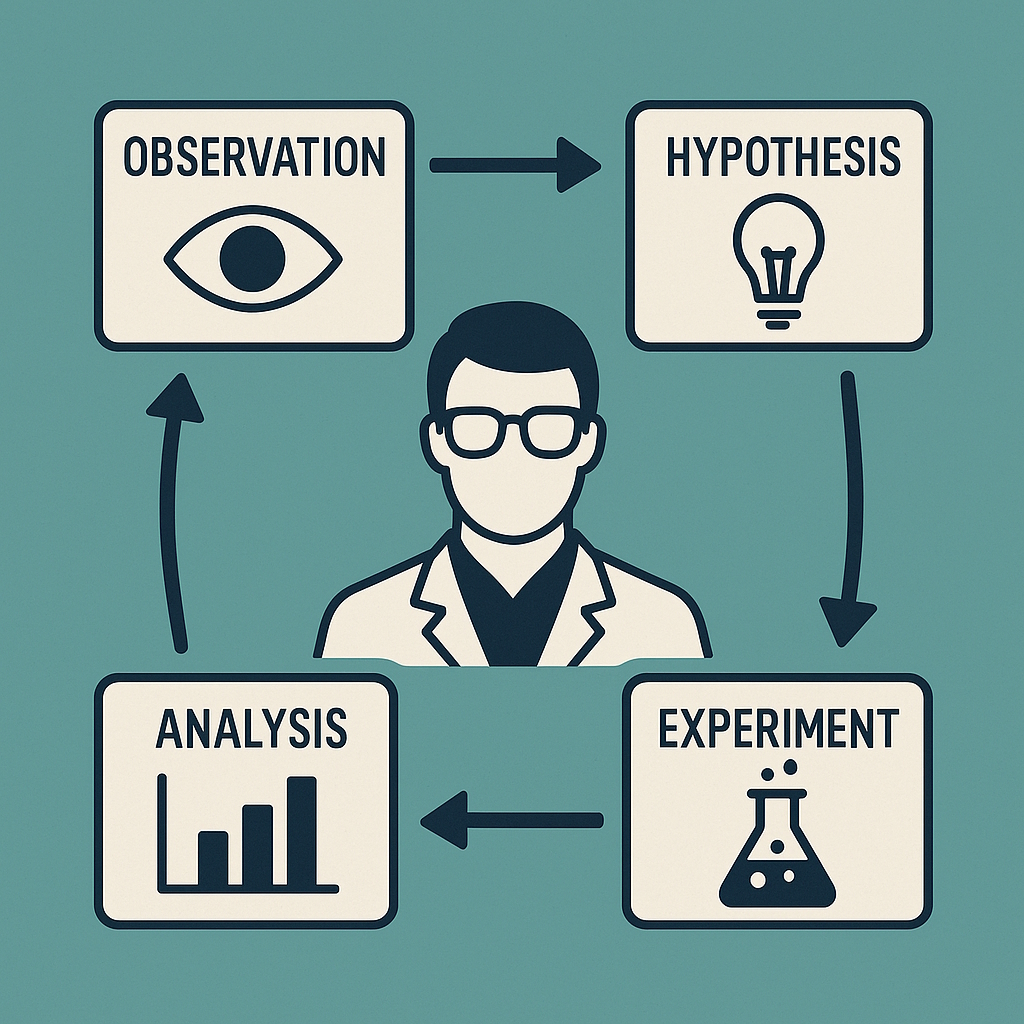
Science is not merely a body of knowledge; it is a way of thinking.
The idea that knowledge emerges through observation, experimentation, and logical analysis was born during the Renaissance. In the early 17th century, the English thinker Francis Bacon proposed a new approach to the search for truth: not through authority or metaphysics, but through systematic empirical study.
Bacon’s method, based on inductive reasoning and sensory evidence, laid the foundations for what we now call the scientific method. Later, Galileo Galilei showed that measurement is the language through which nature speaks. Through his experiments, he overturned centuries of theory and demonstrated that science requires evidence, not belief.
In the centuries that followed, Karl Popper added another critical principle: a theory is scientific only if it can be tested and potentially falsified. Thus, the scientific method took its modern form: observation, hypothesis, experiment, analysis, conclusion, and reassessment.
In the chemist’s laboratory, this principle becomes a matter of daily practice. The design of a new formulation, the selection of raw materials, the statistical analysis of results — all follow the same pattern: design, test, measure, improve.
Research and development is never a linear process. It is a cycle in which every failure teaches something and every success generates new questions. A chemist never truly completes a project. They evolve it.
This cyclical path of inquiry, born within science, also found its place in industry through quality standards. The well-known PDCA cycle — Plan, Do, Check, Act — is nothing other than the institutional form of the scientific method.
In Plan, we formulate the hypothesis. In Do, we apply it. In Check, we measure the results. And in Act, we use them for improvement.
As in the laboratory, so too in an ISO system, the essence lies not in formal compliance, but in a mindset of continuous verification. Quality is not a bureaucratic process. It is the logic of experimentation itself.
In paint chemistry, the scientific method is revealed more clearly through failures than through successes. When a paint yellows, peels, or foams, the scientist does not rush to blame the product or the substrate.
They begin the investigation as a researcher would in the field. They define the possible causes, collect data, eliminate hypotheses, and verify results. They analyse samples, check raw material compatibility, assess correct application, and evaluate climatic conditions.
Every step is a miniature version of the scientific method: observation, hypothesis, testing, evaluation.
Failures are not simply failures; they are feedback. They reveal the limits of our knowledge and become a guide for the next improvement.
In the paint industry, experimental thinking is what turns a quality problem into an opportunity for progress. The same logic applies to ISO systems, where the investigation of non-conformities is not punitive, but corrective and improvement-oriented.
Root cause analysis is, in essence, an application of the scientific method to quality management.
The culture of documentation is what separates research from improvisation. There is no progress without evidence, just as there is no quality without records.
From the lab book to an Environmental Product Declaration — EPD — the logic is the same: whatever you claim must be repeatable, verifiable, and demonstrable.
This is also the essence of professionalism in the chemical industry, where creativity meets precision.
The scientific method is not simply a tool of research; it is an attitude towards life. It is the decision to trust data more than impressions, to question what appears self-evident, and to seek evidence before reaching conclusions.
In the age of information, where anyone can appear to be an expert, scientific thinking remains the only path towards truth.
And perhaps, in the end, this is the deeper meaning of quality: a continuous effort to become slightly better than yesterday, based on evidence rather than impressions.