

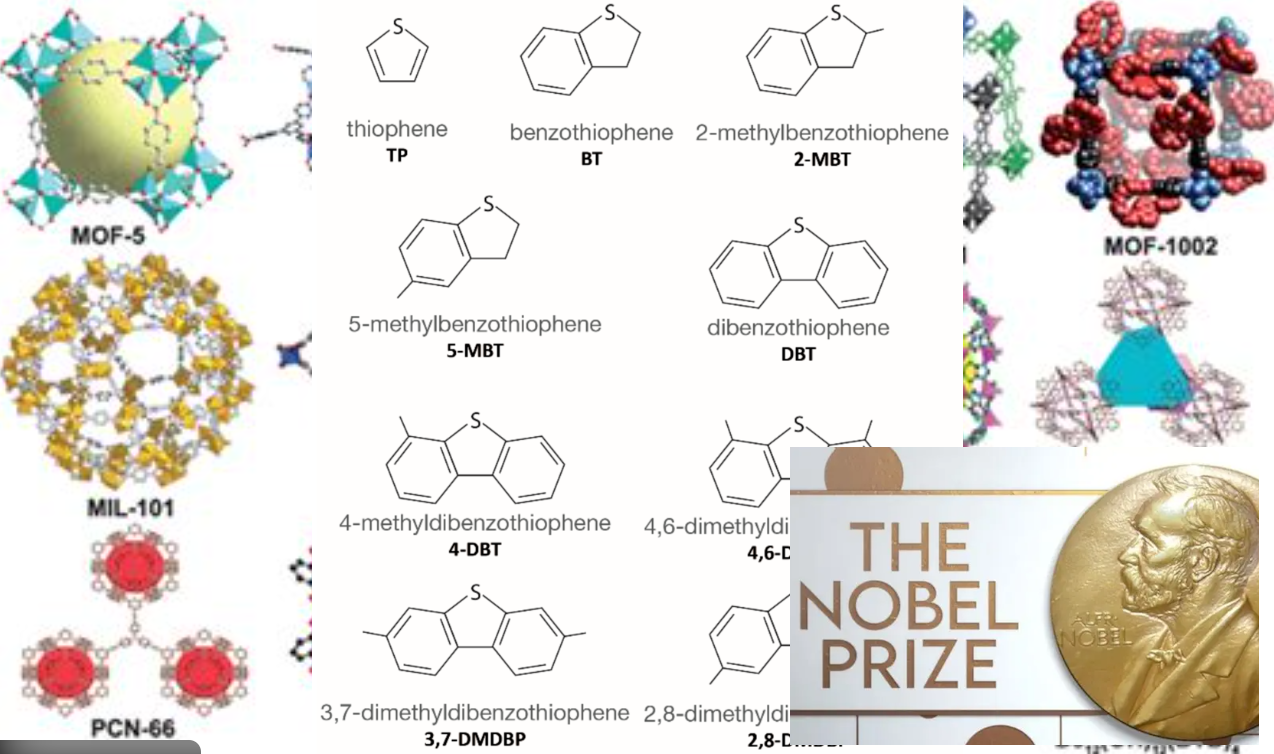
On 8 October 2025, the Nobel Committee awarded the Nobel Prize in Chemistry to Susumu Kitagawa, Richard Robson, and Omar Yaghi “for the development of metal–organic frameworks — MOFs”. The prize recognised the fundamental importance of MOFs as materials with exceptional characteristics: highly porous structures, tunable chemistry, large surface area, and the ability to undergo functional modification.
This distinction is expected to further increase interest in large-scale MOF applications, particularly in the field of coatings, where the properties they offer are exceptionally promising.
Coatings chemists know very well that materials are exposed to complex environments: humidity, UV radiation, temperature fluctuations, microbial load, and more. The introduction of materials such as MOFs into coating systems offers new possibilities that were previously impossible to achieve with a single material.
What Are MOFs?
MOFs are metal–organic frameworks: a class of crystalline materials with a porous structure formed by metal ions or clusters and organic linkers.
Some of their key properties include:
- High specific surface area — some MOFs exceed 7,000 m²/g.
- Tunable porosity — pore size and arrangement can be controlled.
- Adaptability — different metals and organic modifications can be selected.
- Filtration, absorption/release, catalytic activity, and gas storage.
- Chemical and thermal stability, depending on the specific MOF.
In coatings, MOFs can function as:
- Barrier fillers, limiting the diffusion of molecules such as water and ions through polymer matrices.
- Nanocontainers or carriers of active substances, such as corrosion inhibitors or antimicrobial agents, with controlled release.
- Thin smart films — SURMOFs / surface-mounted MOFs, offering selective permeability or sensing functions.
- Catalytic or photocatalytic centres, incorporated into the coating surface for the degradation of pollutants or VOCs.
The main challenge is the incorporation of MOFs into resins or coating formulations with suitable compatibility, stability, avoidance of agglomeration, and preservation of their original properties.
MOFs in Coatings — Current Applications and Examples
Anticorrosion Protection
The most developed application of MOFs is in protective coatings for metals. MOFs such as UiO-66, ZIF-8, MIL-101, and HKUST-1 are incorporated into epoxy or polyester resins as fillers or nanocontainers.
They act as barriers against the penetration of water and oxygen, reducing corrosion on metal surfaces.
- In many cases, the MOF is “loaded” with a corrosion inhibitor, such as indazole, benzotriazole, or other organic inhibitors, which is released under specific conditions, for example, a change in pH.
- They have shown excellent performance in epoxy formulations, where they are incorporated as fillers to enhance mechanical strength and self-healing ability.
- Research studies have demonstrated significant slowing of corrosion and increased durability in salt spray tests.
In more advanced systems, MOFs have been incorporated into smart coatings where the MOF “senses” changes in the environment and changes behaviour, for example through colour indication or conductivity changes, before severe corrosion becomes visible.
Antimicrobial and Biomedical Coatings
MOFs containing metals such as Ag⁺, Cu²⁺, or Zn²⁺, or MOFs that provide photocatalytic properties, have been applied to surfaces for antimicrobial action.
- Such coatings can be used on medical surfaces, in facilities where hygiene is critical, or in pipelines used in the food and pharmaceutical industries.
- In medical implants, surface MOF coatings can improve biocompatibility and enable controlled drug release.
- Key points of attention include toxicity limitation, MOF stability in liquid environments, and resistance to pH fluctuations.
Fire-Retardant Coatings and Thermal Protection
Certain MOFs, or MOF-derived materials such as MOF-derived oxides and layered double hydroxides — LDH — have been tested as flame-retardant additives.
- When exposed to flame, they can help form a protective char layer, capture free radicals, and delay heat transfer.
- These systems often require modification or combination with other additives, such as phosphorus- or nitrogen-containing compounds, to increase effectiveness.
- The challenge is to ensure that the optical and mechanical properties of the material are not degraded.
UV Shielding, Photostability, and Protection Against Photoageing
Certain MOFs, especially Zr-MOFs such as UiO-66, can absorb UV radiation and may be incorporated into transparent paints or varnishes to protect polymers from UV exposure.
- Their use in walls, exterior wood surfaces, and architectural coatings has already been proposed.
- MOF additions have been reported to reduce the rate of colour change and yellowing, without causing surface haze.
SURMOFs and Thin Films
Surface-mounted MOF technology — SURMOFs — enables the deposition of controlled, homogeneous, nanostructured MOF films onto substrates through methods such as layer-by-layer epitaxy and CVD-like techniques.
- In coatings, this opens the way for ultra-thin functional barriers, selectively permeable layers, or sensing surfaces integrated into the final film.
- This field remains more experimental, but it is considered the “next frontier” for high-end coatings where additional functionality is required without sacrificing transparency or levelling.
Prospects and Challenges
Prospects
- Multifunctional coatings: combining anticorrosion, antimicrobial, flame-retardant, and sensing functions in a single material.
- Smart stimuli-responsive coatings: systems in which the MOF responds to pH, ions, humidity, or light and “self-regulates”.
- Scale-up and lower cost: development of economical MOF synthesis routes on a large scale with reproducibility.
- Connection with digital systems: corrosion sensors or microporous layers that communicate with IoT systems, for example in infrastructure monitoring.
- Sustainability and safety: MOFs based on abundant, non-toxic metals such as Fe and Al, combined with green synthesis routes and compatibility with environmental standards such as REACH, CLP, and LCA.
Challenges
- Stability: many MOFs hydrolyse or lose their properties, which is particularly critical in coatings exposed to environmental conditions.
- Dispersion and compatibility: avoiding agglomeration, achieving good wetting within the resin, and maintaining optical and rheological properties.
- Controlled release: designing the release or triggering mechanism for stable performance and avoiding a single burst-release event.
- Toxicity and leaching: especially when metals such as Ag or Cu are used, migration and safe-use assessments are required.
- Production cost and reproducibility: scale-up to industrial production remains a major challenge.
- Integrated testing across different sectors: long-term testing, simulations in aggressive environments, and compatibility with substrates and coating processes are required.
Conclusions
The 2025 Nobel Prize has highlighted that MOFs are not merely laboratory materials, but a chemical toolbox for innovative coatings, inviting chemists to explore almost unlimited possibilities.
In the coatings field, MOFs open the way for coatings with higher performance, smart behaviour, and multifunctionality — ideally suited to modern needs such as sustainable materials, digital monitoring, and enhanced durability.
As R&D chemists, we have the opportunity to transfer these developments from proof of concept to high value-added applications, while at the same time addressing the practical challenges: stability, compatibility, safety, cost, and scale-up.
If we proceed carefully, through gradual pilot projects, intermediate benchmarks, and field testing, MOFs may represent the next major leap in the evolution of coatings.
Bibliography
Nwokolo, I. K., Shi, H., & Liu, F. (2025). MOF-based protective coatings for metal corrosion protection: A critical review of design, synthesis, performance, and mechanism. Materials Science and Engineering B, 313, 117932.
Metal-Organic Framework — MOF / Epoxy Coatings: A Review. PMC open access.
Ansari, K. R. et al. Progress in Metal-Organic Frameworks — MOFs — as Multifunctional Materials: Design, Synthesis and Anticorrosion Performance Techniques. Review article.
Recent Advances in Surface-Mounted Metal–Organic Framework Thin Films. Biomaterials Research / PMC.
Two-Dimensional Metal–Organic Frameworks / Epoxy Composite Coatings with Superior O₂ / H₂O Resistance for Anticorrosion Applications. ACS Applied Materials & Interfaces, 2024.
Nano-Metal–Organic Frameworks as Corrosion Inhibitors for Steel. RSC Publishing.
A Review of Metal-Organic Framework Protective Coatings for Light Metals. SAGE Journals.
Polyester-Based Coatings with a Metal Organic Framework: An Experimental Study for Corrosion Protection. MDPI.
Synthesis and Evaluation of CuNi-MOF as Corrosion Inhibitor for Stainless Steels. PMC.