

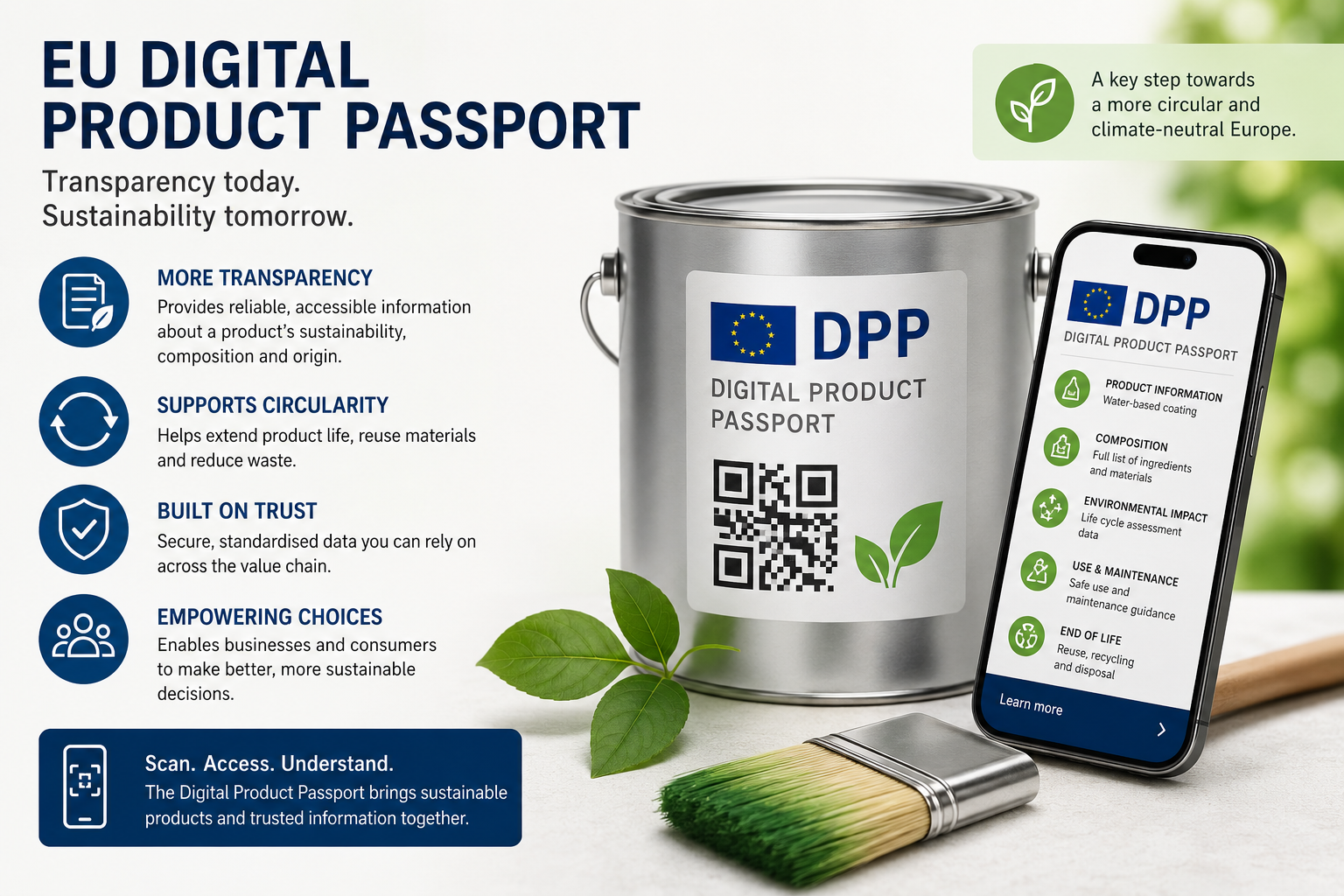
The Digital Product Passport — DPP — represents one of the most substantial interventions by the European Union in the way products placed on the market are designed, documented, and assessed.
For the building materials and paints sector, the DPP should not be seen as an abstract digital concept or as yet another regulatory “tick-box”. On the contrary, it functions as a mechanism intended to bring together, within a single digital structure, all the information that is currently fragmented across technical datasheets, certifications, declarations of performance, and environmental studies.
The introduction of the DPP is directly linked to the Ecodesign for Sustainable Products Regulation — ESPR — and forms part of the EU’s broader strategy for the transition towards a more transparent and circular product market.
Within this new framework, the availability of reliable and comparable data is not merely a technical convenience. It is becoming a condition for compliance and, gradually, a competitive advantage.
For building materials, and especially for paints, the DPP is particularly important. The sector already has a high level of technical and regulatory documentation. Technical datasheets, safety data sheets, CE marking, declarations of performance, and environmental product declarations are already in place.
The issue is not the absence of information. The issue is that this information is static, dispersed, and often disconnected from the real context in which the product is used.
The DPP is intended to act as the digital backbone connecting these data points, making them accessible and usable throughout the value chain.
In practice, a Digital Product Passport for building materials and paints is not just a file or a digital “label”. It is a dynamic digital structure that starts with the basic identity of the product and extends to its regulatory compliance, environmental performance, application conditions, and ultimately the way the product fits into a wider system throughout its life cycle.
Particular importance is given to the section on regulatory and technical compliance. The DPP does not replace CE marking, the Declaration of Performance, or the European standards covering a product. Instead, it connects them within a single digital environment, making control, verification, and understanding of the requirements easier.
In this context, the link with the new Construction Products Regulation — CPR 2024/3110 — becomes especially significant, as the DPP can function as a tool for monitoring compliance at product level, rather than merely at document level.
From an environmental perspective, the DPP does not aim to replace Life Cycle Assessment or Environmental Product Declarations. On the contrary, it is based on them.
For paints and building materials, the EPD is expected to become the core source of environmental information incorporated into the DPP, together with indicators such as carbon footprint, VOC content, and declarations relating to PFAS or microplastics, where these are relevant and properly documented.
The quality and scientific validity of these data will largely determine the credibility of the DPP itself.
One element of particular importance for paints is the information related to application and use. Unlike many other products, the performance of a paint depends heavily on application conditions, film thickness, compatibility with the substrate, and maintenance cycles.
Including such data in the DPP is not simply a technical detail. It is a fundamental requirement for a realistic assessment of the product’s service life and environmental behaviour.
Similarly, end-of-life considerations for building materials and paints cannot be treated in isolation. Paints are not recycled independently; rather, they affect the recyclability or reusability of the substrate to which they are applied.
The DPP is expected to capture these interactions without oversimplification or embellishment, providing realistic technical information.
It is also important to state clearly that the DPP is not a marketing tool, nor does it imply the disclosure of formulations or intellectual property. The information it contains concerns functional, regulatory, and environmental data, at the level defined by European legislation.
Although concerns about formulation disclosure are understandable, they are not justified within the framework of DPP requirements.
Preparing for the Digital Product Passport does not start with choosing a digital platform. It starts with the internal organisation of data, the quality of technical and environmental declarations, and collaboration between R&D, Quality, and Regulatory teams.
Companies that invest early in this structured approach will not merely achieve compliance. They will gain a stronger position in a regulatory environment that is changing rapidly and substantially.