

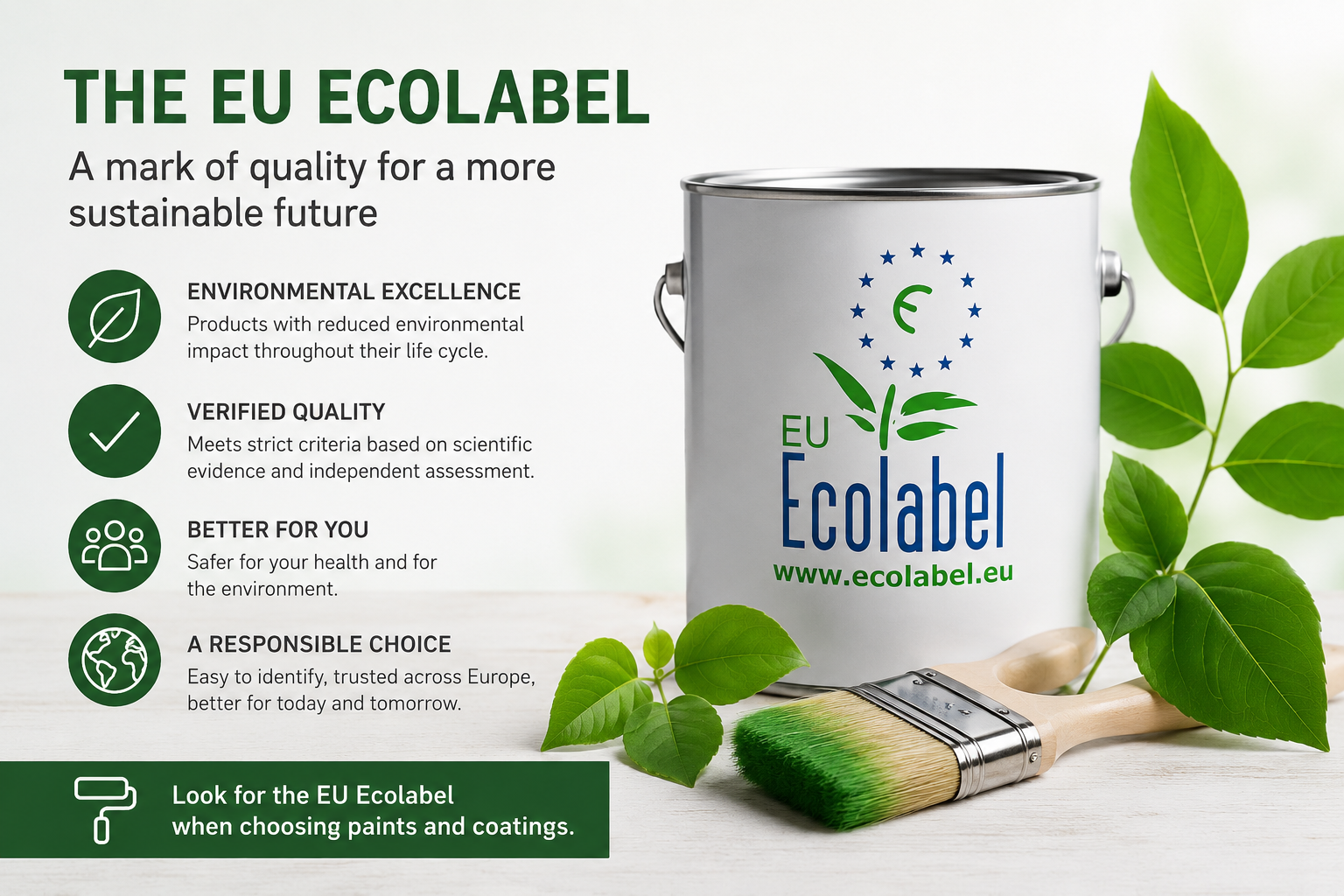
Τhe European Commission has issued Decision (EU) 2025/2607 of 17 December 2025, establishing the new, updated criteria for awarding the EU Ecolabel to paints, varnishes, and related products. This new decision repeals the previous Decision 2014/312/EU, aiming to strengthen the circular economy, reduce the use of hazardous substances, and promote products with the lowest possible environmental footprint throughout their life cycle.
Key Changes in the Structure of the Criteria
Unlike the previous framework, which included a single product category, the new criteria are now divided into three distinct categories, each with its own code:
- Decorative paints, varnishes, and related products — Code 044.
- Special performance coatings, such as floor paints and anti-corrosion coatings — Code 056.
- Water-based aerosol spray paints — Code 057.
The new criteria will remain valid until 31 December 2032.
Technical Requirements: Where Should the Industry Focus?
Paint producers are now required to comply with stricter limits and new testing procedures.
- VOC and SVOC restrictions:
While the limits for Volatile Organic Compounds — VOCs — remain strict, for example 10 g/l for interior matt paints, the limits for Semi-Volatile Organic Compounds — SVOCs — have been further reduced. For instance, for white interior wall paints, the limit is now 25 g/l, compared with the previous limit of 30 g/l. - VOC emissions — Criterion 5:
For indoor products, mandatory chamber emission testing is introduced at 3 and 28 days. Total TVOC emissions after 28 days must not exceed 300 μg/m³, while a strict limit is also set for formaldehyde, at ≤ 10 μg/m³. - Ban on hazardous substances:
The new criteria include an explicit ban on the use of PFAS — per- and polyfluoroalkyl substances — and restrictions on non-film-forming synthetic polymer microparticles — SPM — unless an environmental benefit can be demonstrated. In addition, no substance of very high concern — SVHC — is permitted at concentrations above 0.010%. - Titanium dioxide — TiO₂ — production:
Enhanced documentation requirements are introduced for environmental performance and health and safety conditions during TiO₂ production, including the control of dust exposure in workplaces. - Consumer information:
Packaging must now include instructions on how to minimise waste and properly manage waste streams. These instructions may also be provided through QR codes or online links.
Transitional Provisions and Deadlines
Companies that already hold the EU Ecolabel under the previous decision — 2014/312/EU — will have an 18-month transition period from the date of application of the new decision to adapt their products and obtain certification under the new criteria.
New applications may be submitted under either the old or the new criteria only during the first two months of the transition period.
How Can the Institute of Coating Technologies Support You?
Preparing the technical dossier for the EU Ecolabel requires detailed data collection from suppliers, laboratory emission testing, and accurate formulation calculations.
At the Institute of Coating Technologies, we have in-depth knowledge of the new requirements introduced by Decision (EU) 2025/2607 and can fully undertake the preparation of EU Ecolabel dossiers for your company.
From formulation assessment and communication with raw material suppliers, to the coordination of the required testing and submission to the competent authority, we ensure a smooth transition of your products to the new standards.
Contact us to start the certification process for your products.