

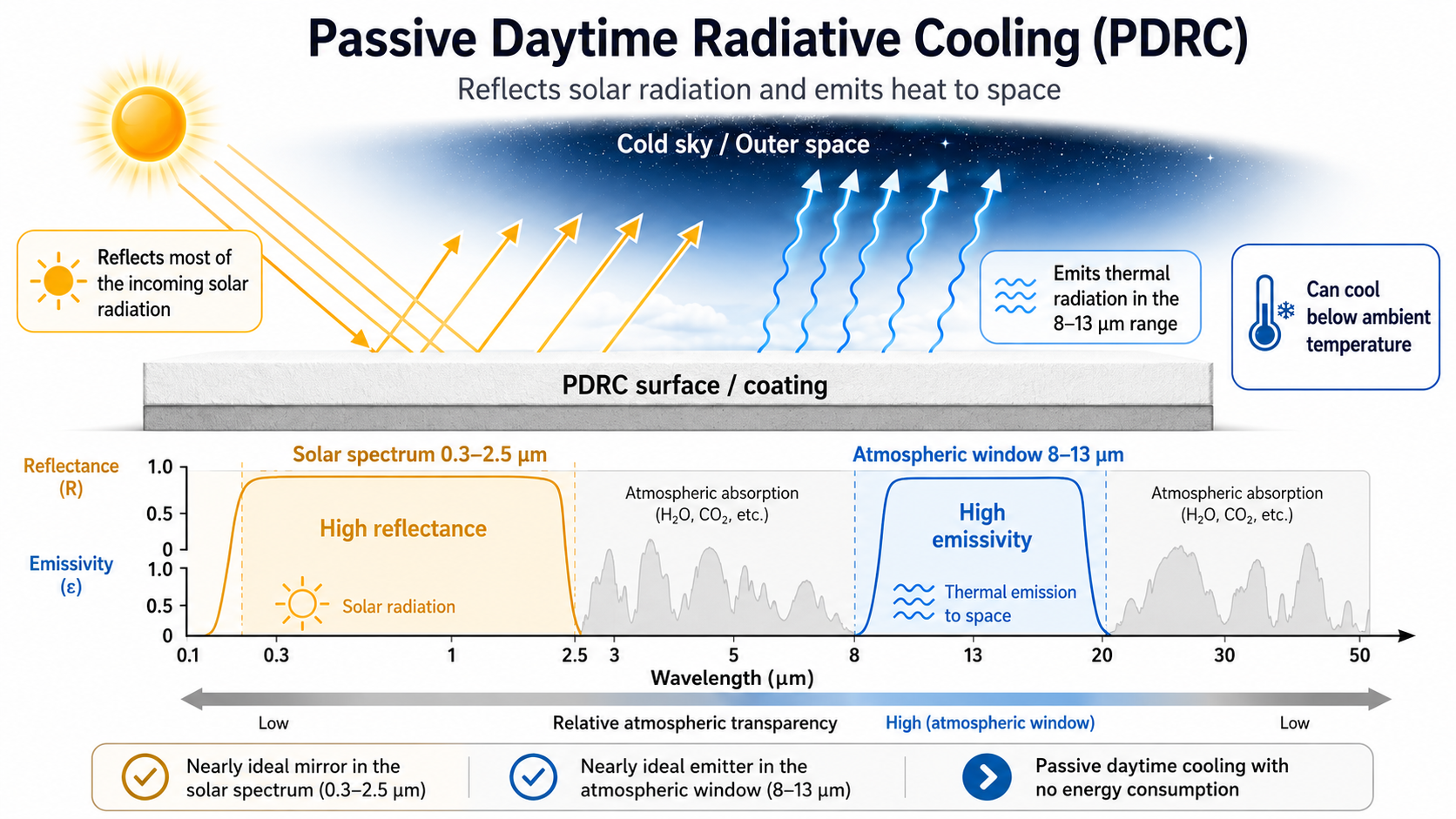
The growing demand for cooling in buildings and infrastructure, under conditions of climate crisis and energy stress, is creating the need for new technologies that reduce thermal loads without additional electricity consumption. In this context, Passive Daytime Radiative Cooling (PDRC) is emerging as one of the most promising solutions: a purely passive technology that allows surfaces to cool below ambient temperature even under full sunlight.
What is Passive Daytime Radiative Cooling?
PDRC is a form of passive cooling that exploits the emission of thermal radiation towards the “cold sky” through the so‑called atmospheric window, i.e. the 8–13 μm region in the infrared spectrum where the atmosphere is relatively transparent.
A surface designed for PDRC aims to achieve two things simultaneously:
-
very high solar reflectance (0.3–2.5 μm), in order to avoid absorption of solar radiation,
-
very high thermal emittance in the 8–13 μm region, in order to reject heat to outer space.
When these conditions are met, the net radiative heat flux can exceed the thermal gains from the sun and warm air, leading to sub‑ambient cooling.
Optical design and materials for PDRC paints
The core of PDRC technology lies in the spectral engineering of coatings. The goal is to tailor an optical response such that the surface behaves almost like an ideal mirror in the solar spectrum and almost like an ideal emitter in the infrared region of the atmospheric window.
Representative material strategies include:
-
high‑whiteness polymeric coatings containing TiO₂, BaSO₄ or other inorganic fillers that provide strong scattering and reflectance in the visible and NIR,
-
inorganic fillers such as Al₂O₃ or Bi₂O₃, which exhibit strong emittance in the 8–13 μm region,
-
multilayer thin‑film structures with alternating materials of different refractive index, enabling fine tuning of the spectral response.
Microstructure plays a critical role: scattering particles with appropriate size (Mie scattering), porous structures and rough surfaces increase the optical path length and the overall reflectance. At the same time, from a coating chemistry perspective, binders with high UV–Vis transparency, stable dispersion at high PVC, and resistance to UV, humidity and pollution are required.
Energy and environmental benefits
In contrast to active cooling technologies, which consume electricity and discharge heat into the immediate environment, PDRC systems reject heat directly to outer space without moving parts or power consumption.
Integrating PDRC paints into roofs, façades and urban elements can:
-
reduce surface temperatures and, consequently, building cooling loads,
-
mitigate the urban heat island effect,
-
lower peak electricity demand for air conditioning, contributing to reduced CO₂ emissions.
Recent studies show that, under favorable climatic conditions, a properly designed PDRC surface can achieve significant levels of sub‑ambient cooling, with temperatures several degrees below the surrounding air.
Challenges for industrial implementation
Although the underlying principle is scientifically mature, large‑scale deployment of PDRC via commercial paints comes with practical challenges. The accumulation of dust and pollutants on the surface reduces both reflectance and emittance, leading to a gradual decline in cooling performance. In addition, the effectiveness is strongly dependent on climatic factors (cloud cover, humidity, atmospheric composition), which necessitates tailored solutions for each geographical region.
From the viewpoint of the coatings industry, issues such as adhesion to different substrates, mechanical durability, UV stability, color requirements (e.g. non‑white surfaces) and compatibility with existing coating systems must be addressed systematically.
Outlook for the coatings industry
For the paint and coatings industry, PDRC represents a characteristic example of a “functional coating” that directly links microstructure design with the energy performance of the building envelope. Current trends include the development of superhydrophobic PDRC coatings with self‑cleaning behavior, biomimetic structures inspired by natural high‑reflectance surfaces, and combinations of PDRC with other technologies such as cool roofs, thermochromic materials and photovoltaics.
References
Yang, S., Li, T., Zhang, X., & others. (2021). Passive daytime radiative cooling: Fundamentals, material designs, and applications. EcoMat, 3(3), e12153.
Li, Z., Ni, Y., & others. (2021). Review on passive daytime radiative cooling: Fundamentals, recent researches, challenges and opportunities. Renewable and Sustainable Energy Reviews, 141, 110794.
Zhao, Z., & others. (2025). Progress in passive daytime radiative cooling from spectral design to real application. Carbon Future, 4(1), 33–52.
Recent advances in passive daytime radiative cooling coatings: Fundamentals, strategies and prospects. (2024). Progress in Organic Coatings, 190, 107123.