


Trend Analysis from BASF’s 2023 Automotive Color Report
In a recent trend study published last autumn, BASF referred to the traditional automotive color palette, which is currently undergoing a process of transformation.
BASF’s 2023 Color Report for Automotive OEM Coatings provides the data supporting this trend.
Achromatic automotive colors — white, black, silver and grey — have always formed the foundation of automotive color design. However, they are now showing a significant shift.
While white continues to hold its position as the most popular color for light passenger vehicles, its market share has decreased significantly. By contrast, black is gaining market share at the expense of white.
Consumer preferences also differ between regions around the world. For example, in North America, there is a growing preference for lighter shades of silver over darker greys, while in EMEA — Europe, Middle East and Africa — the trend is moving towards darker shades.
This regional differentiation adds an interesting dimension to the evolving world of automotive color.
At the same time, chromatic colors remain stable, without significant changes in their total market share, which stands at 19%. This category includes a variety of colors such as blue, red, brown and beige, which continue to maintain their popularity among consumers.
EMEA: Different Color Preferences by Country — The Dominance of Achromatic Shades
Achromatic colors — white, black, grey and silver — gained two percentage points in Europe, the Middle East and Africa.
Car buyers shifted their interest away from the bright colors, white and silver, towards the darker shades of black and grey.
High-end cars featured more pearl effects compared with entry-level and mid-price categories, highlighting the depth and creativity of color.
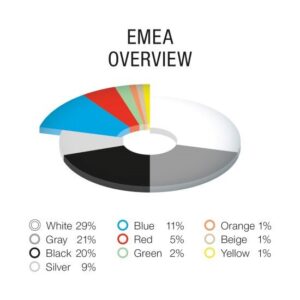
When European consumers choose colors, they show specific preferences that vary from country to country:
- Germany loves blue — 11%.
- Spain and the United Kingdom prefer red and orange — around 9%.
- France loves green — 6%.
- Italy expresses its love for all colors, with the highest share of chromatic colors among the five countries.
“While achromatic colors remain the most popular, every country seems to have its favourite place in the color spectrum,” said Mark Gutjahr, Global Head of Automotive Color Design at BASF.
“Different color distributions can be observed in every major country in EMEA. Our customers, the car manufacturers, have now allowed much more room for creativity at dealerships, and car buyers are taking advantage of this.”
North America: Lighter Colors and More Pearl Effects
As in EMEA, achromatic colors in North America — white, black, silver and grey — gained a total of two percentage points.
Consumers moved in a brighter direction after several grey shades were discontinued by car manufacturers. These were often replaced by shades of silver.
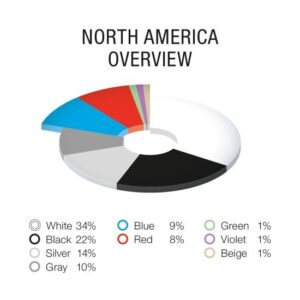
North America also had the highest share of red cars compared with other regions in 2023. However, red was not able to overtake blue as the most popular chromatic color in North America.
“We are experiencing the same shift seen in other regions,” said Elizabeth M. Hoffmann, Color Designer for North America.
“The old standard color palette no longer applies. Light shades are becoming increasingly popular, taking market share from grey. More and more options now include effect pigments to give them intensity and excitement.”
Asia-Pacific: Growth of Chromatic Colors with More Variations in Effects
Continuing its leading role in the new automotive color palette, the share of chromatic colors in Asia-Pacific was slightly higher than in 2022.
The popularity of natural colors increased, especially green. Light colors also became more popular, particularly light greyish tones and silver.
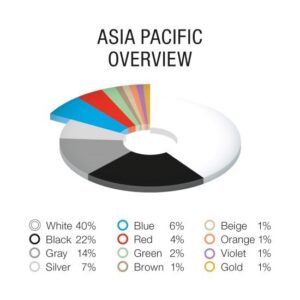
“As different new vehicles arrive on the roads, it is natural that a more vibrant color palette will follow,” said Chiharu Matsuhara, Head of Automotive Color Design for Asia-Pacific.
“With new car manufacturers creating new vehicles in Asia, they are asking for more than the usual color wheel. They want something bold and creative in their new designs, and younger consumers appreciate these colors.”
South America: Still the Region with the Highest Share of Achromatic Colors
South America has historically taken a conservative approach to automotive colors, with a very high share of achromatic colors in 2023.
In total, 86% of new vehicles produced in South America had either a white, black, silver or grey body, the highest percentage among all regions.
The share of silver is also higher in South America than in other regions.
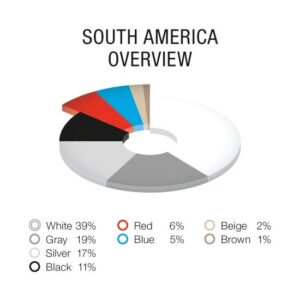
In this market, more and more car manufacturers are choosing color effects to make achromatic colors stand out.
Compared with 2022, more cars were delivered with color effects across all body sizes.
“Colors are no longer just colors. They are experiences,” said Marcos Fernandes, Director of BASF Coatings South America.
“Whether it is pearl, metallic or another pigment effect, effects make color stand out in the eyes of the viewer. They create a specific feeling that is becoming increasingly popular.”
The BASF Color Report for Automotive OEM Coatings is a data analysis by BASF’s Coatings division, based on global automotive production and color application in non-commercial vehicles in 2023.
Source: PCI — Painting & Coating Industry.